Themendossier: Postwachstum und Raumentwicklung
 In der politischen und gesellschaftlichen Debatte über die Notwendigkeit einer Transformation zu nachhaltigen Lebens- und Wirtschaftsformen stehen neben dem Klimawandel insbesondere die Endlichkeit natürlicher Ressourcen und der global fortschreitende Ressourcenverbrauch im Mittelpunkt. Zunehmend wird die Sinnhaftigkeit von kontinuierlichem materiellem Wachstum infrage gestellt und es werden Entwicklungsansätze jenseits einer reinen Wachstumsorientierung gesucht. Gemeinwohlorientierung, soziale Teilhabe und Umweltverträglichkeit sind die Leitziele einer Debatte, die die gegenwärtig vorherrschenden Wirtschaftsformen und deren negative Auswirkungen kritisch hinterfragen. Dazu gehört auch eine Neubewertung von Begriffen wie Entwicklung, Wohlstand und Wohlergehen.
Angesichts der Bedeutung dieser Debatte in Politik, Zivilgesellschaft und Teilen der Sozial- und Wirtschaftswissenschaften haben auch die Raum- und Planungswissenschaften begonnen, sich dem Thema „Postwachstum“ zu widmen.
Trotz ihrer langjährigen Auseinandersetzung mit Nachhaltigkeitsfragen und dem Umgang mit der „Ressource“ Fläche/Boden scheinen die gängigen Konzepte und Modelle der Raumforschung und Raumordnung eher dem traditionellen Wachstumsparadigma verhaftet. Weder die Beschäftigung mit dem demografischen Wandel und schrumpfenden Städten noch die Arbeiten zu den Folgen der jüngsten Finanz- und Wirtschaftskrise haben hier zu einem grundsätzlichen Perspektivenwechsel geführt, der konzeptionelle Anstöße für alternative, d. h. nicht an materiellen Wachstumsindikatoren orientierte Entwicklungsmodelle und ihre planerische Begleitung liefern könnte. Auch fehlt es bisher an einer kritischen Diskussion in den Raumwissenschaften zu den Konzepten der sogenannten „Green Economy“ und der „Sharing Economy“ sowie zu Vorstellungen von „Qualitativem Wachstum“ oder „Smart Growth“. Jüngste Arbeiten zur Boden- und Immobilienfrage lassen jedoch einen Trend zu grundlegenderen Auseinandersetzungen erkennen.
Die ARL möchte durch verschiedene Aktivitäten eine differenzierte interdisziplinäre Diskussion zu den räumlichen Implikationen und den Herausforderungen postwachstumsorientierter Konzepte und Projekte ermöglichen und dem Thema in den Raumwissenschaften und der Planungspraxis zu mehr Gewicht verhelfen. Durch das Themendossier „Postwachstum und Raumentwicklung“ möchten wir unsere Aktivitäten und Publikationen gebündelt und transparent abbilden und uns mit Anderen vernetzen.
ARL-Aktivitäten

- Arbeitskreis "Große Transformation und nachhaltige Raumentwicklung"
- Arbeitskreis "Wohlstandsalternativen und Regionalentwicklung"
- Arbeitskreis "Postwachstumsökonomien"
- Arbeitsgruppe "Alternatives Wirtschaften – Abkehr von der Wachstumsgesellschaft"
- Arbeitsgruppe "Postwachstum in ländlichen Räumen" des Forum Nachwuchs
- ARL-Kongress 2019: Postwachstum und Transformation

Hier geht es zur Bildergalerie
Ergebnisse und Veröffentlichungen
- Was heißt hier normal? Denk- und Machtanstöße für die kommunale Planungspraxis in ländlichen Räumen (Ergebnisse und Empfehlungen der Arbeitsgruppe "Postwachstum in ländlichen Räumen" des Forum Nachwuchs, 2023)
- Post-Growth Geographies. Spatial Relations of Diverse and Alternative Economies (transcript, 2022)
- Postwachstum und Raumentwicklung: Denkanstöße für Wissenschaft und Praxis (Positionspapier der ARL, 2021)
- Nachhaltige Raumentwicklung für die große Transformation – Herausforderungen, Barrieren und Perspektiven für Raumwissenschaften und Raumplanung (Forschungsbericht der ARL, 2021)
- Der Beitrag nachhaltiger Raumentwicklung zur großen Transformation – Impulse für neue Strategien (Positionspapier der ARL, 2021)
- Postwachstumsgeographien. Raumbezüge diverser und alternativer Ökonomie (transcript, 2020)
- Möglichkeitsräume. Raumplanung im Zeichen des Postwachstums (Zeitschrift Politische Ökologie, 2020)
- ARL-Kongress 2019
- Video-Teaser (ARL-Kongress 2019)
- Video-Statements (ARL-Kongress 2019)
Der Beitrag "Covid-19 und Postwachstumsgeographien: Beobachtungen und Perspektiven" entstand neben weiteren hier aufgelisteten Produkten durch die Zusammenarbeit der Herausgebenden im Arbeitskreis „Postwachstumsökonomien“ der ARL. Während unsere Veröffentlichungen im transcript Verlag („Postwachstumsgeographien“) und im oekom Verlag („Möglichkeitsräume“) ihren Redaktionsschluss kurz vor dem Ausbruch der Corona-Krise hatten, möchten wir erste Bezüge und Brücken zwischen Postwachstumsgeographien und den räumlichen Auswirkungen der Pandemie vorstellen. Im Zuge der Krise verstärkt aufkommende Debatten über alternative Lebensstile, Arbeitsformate, Mobilitätsverhalten und andere Routinen zeigen – teilweise explizit, teilweise implizit – klare Bezüge zu Postwachstumsansätzen. Innerhalb des Arbeitskreises war es uns ein Bedürfnis, die raumrelevanten Zusammenhänge der Pandemie zu Postwachstumsideen und die Gestaltbarkeit einer Nachhaltigkeitstransition herzustellen. Oben geht es zum Beitrag „Covid-19 und Postwachstumsgeographien: Beobachtungen und Perspektiven“.
Krisen als Chance? Der Sammelband "Postwachstumsgeographien" bietet fundierte Ideen und Inspirationen zu Wohlstandsalternativen
Der Band "Postwachstumsgeographien" untersucht die Raumbezüge diverser und alternativer Ökonomien im Spannungsfeld von wachstumsorientierten Institutionen und multiplen sozialökologischen Krisen. Die Beiträge greifen diesen Ansatz erstmals umfassend auf und eröffnen mit konzeptionellen und empirischen Fachbeiträgen aus der Geographie und deren Nachbardisziplinen verschiedene Perspektiven auf die Möglichkeiten, Forderungen und Kritiken einer sozialökologischen Transformation. Aktuelle Diskussionen zu Postwachstumsökonomien werden aus geographischer Sicht präzisiert und mit Fallstudien und Interviews aus Zivilgesellschaft, Planung und Politik ergänzt.
Was andere zu diesem Band sagen:


Links

- http://www.postgrowthplanning.com/
- https://www.postwachstumsstadt.de/
- https://www.postwachstum.de/postwachstum-trifft-auf-stadt-und-raumplanung-20171219
- https://konzeptwerk-neue-oekonomie.org/
- https://degrowth.org/
- https://www.communityeconomies.org/
- https://timotheeparrique.com/
***
Bildquellen:
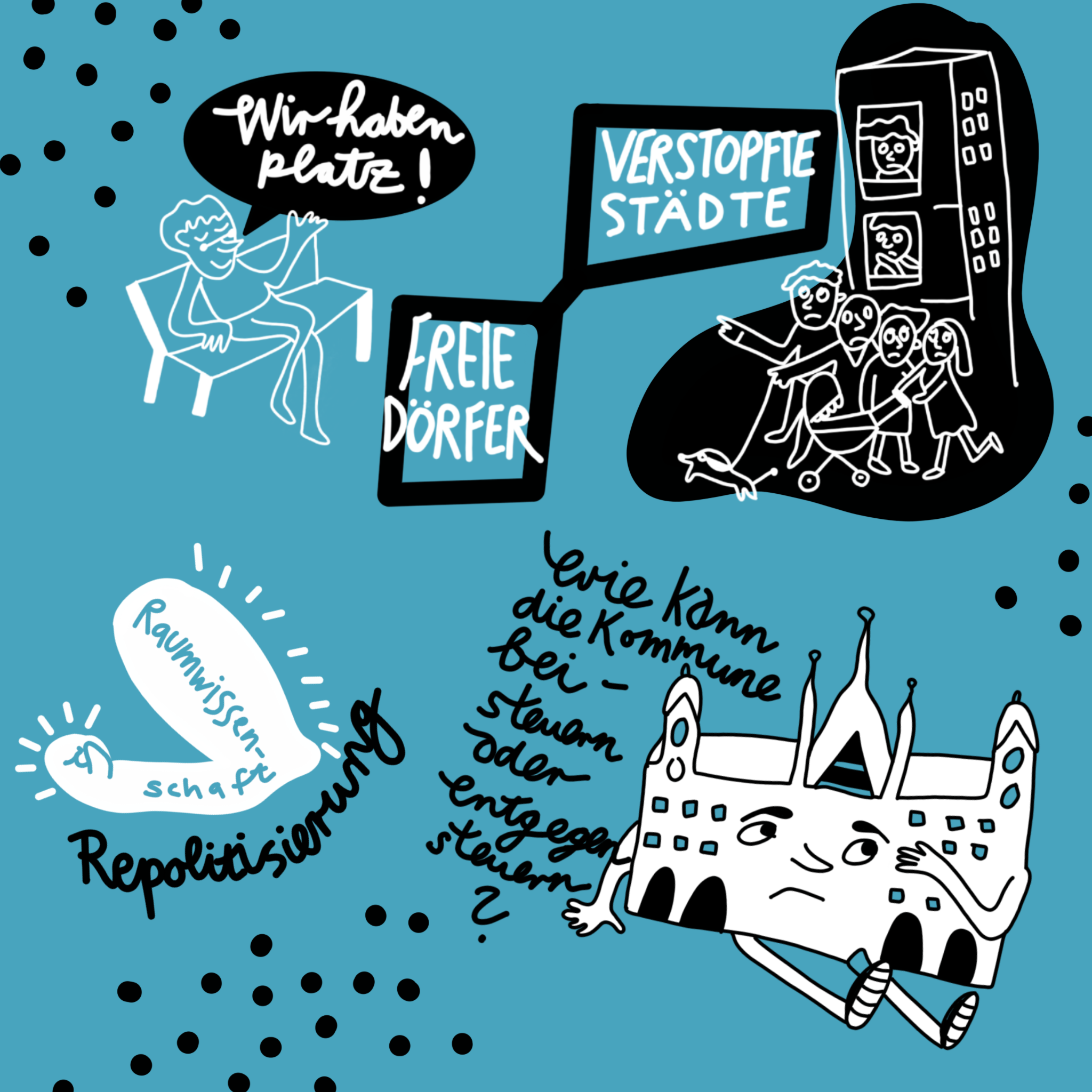
Die auf der Website verwendeten Bilder basieren auf einer von Katrina Günther von "Thinking Visual", Berlin, gestalteten Graphic-Recording-Dokumentation des ARL-Kongresses 2019 in Kassel. Die Zitate in der Bildergalerie entstammen einem Videoprojekt mit kompilierten Interviewsequenzen, dieses ARL-Kongresses. Die Porträtskizzen der Zitierten fertigten Viola Schulze Dieckhoff und Joyce Gosemann.
***
Kontakt
Dr. Martina Hülz (ARL)
Tel. +49 511 34842-28
martina.huelz@arl-net.de